
Statement October 2026Channel All channelsPages read 15 October 2026
Oopbuy payment methods compared for a UK buyer, without a ranking
Five ways in, laid side by side: what each costs where Oopbuy says, how fast it credits, how money comes back out, and what nobody has published.
01Channel by channel, on one page
Everything in this table is quoted from Oopbuy's own pages, read on 15 October 2026. Where an entry says "not stated", we looked and found nothing. That is information too: it tells you which numbers to check on the payment screen.
| Channel | Fee Oopbuy publishes | Time to credit | Currency note |
|---|---|---|---|
| PayPal top-up | 4.5% + $0.30 (Top up page); 3.7% + $0.30 (two FAQ answers) | 1 to 60 minutes; ~3 working days if reviewed; 3 to 7 for e-cheque | converted to USD first |
| Card at checkout | not stated | not stated | runs through PayPal's card form |
| Wise | not stated by Oopbuy | not stated | GBP accepted |
| UK bank transfer | 0.1% + US$7 bank fees | 2 to 3 working days | credited in yuan at the website rate |
| Klarna | Klarna's own terms | not stated | eligibility text names US residents |
02The fee on small, medium and large top-ups
Only two channels have a published fee you can calculate with: PayPal and the bank transfer. On $50, PayPal at 4.5% costs $2.55 and a UK transfer costs $7.05. On $150 they are nearly level. On $400, PayPal costs $18.30 and the transfer $7.40.
The crossover sits at about $152 using the Top up page figure, or $186 using the FAQ's 3.7%. Your own bank's charge for sending abroad comes on top of the transfer's fees and moves that point upwards.
One top-up or two: a cash-flow choice
Funding once may avoid repeating a fixed fee. It also leaves money in the agent account before final freight is known. Funding separately keeps less idle balance but may repeat payment costs or wait times.
Compare those trade-offs using the same expected net balance. Do not send a large speculative amount solely because a historical fee example appears cheaper. Check how unused balance is returned and whether any fees or exchange losses remain.
04Speed: minutes, working days, or unpublished
PayPal is the only channel with a crediting time in minutes, and even that has exceptions: a PayPal risk review usually takes 3 working days and an electronic cheque 3 to 7. Bank transfers take 2 to 3 working days. Wise and card checkout have no published time.
Speed matters most when a goods payment or a supplement is waiting. If you are paying a supplement with a deadline, confirm the current provider timing rather than assuming instant credit.
05How a balance comes back out
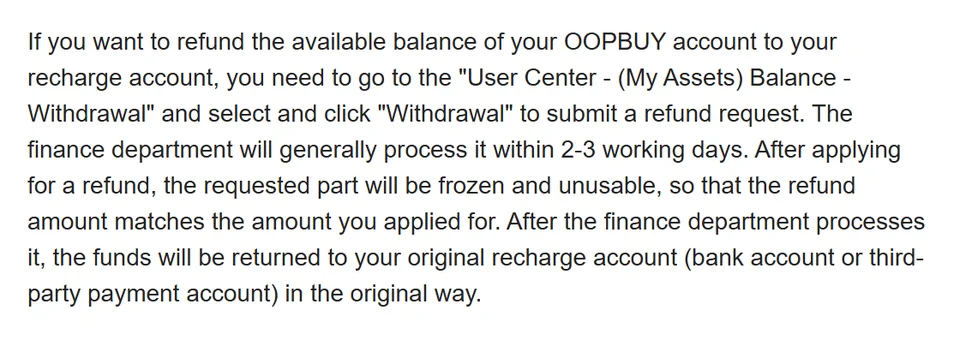
Paying in is half the picture. If you top up more than you spend, the withdrawal FAQ says unused balance goes back to the original recharge account, "bank account or third-party payment account", in the original way. Finance generally processes it in 2 to 3 working days, and the requested amount is frozen meanwhile.
Oopbuy does not say whether the top-up fee is returned with a withdrawal. Assume it is not. That is the strongest argument for topping up close to what the basket needs.
Compare like-for-like before choosing
For each available channel, record the amount debited, currency, payment fee, conversion rate, expected credited balance and status. An old published percentage alone cannot tell you the cheapest or fastest choice today.
If an order deadline is near, confirm the available channel’s timing with support. If a provider is absent from your checkout, do not treat a footer logo or an old help page as a way to activate it.
Try the assumptions in the calculator07What none of the channels tells you
One FAQ explains why cross-border transactions carry fees at all: services "may incur a certain percentage of cross-border transaction fees due to fluctuations in exchange rates, bank cross-border exchange fees, and other factors." It does not say what the percentage is.

That sentence sits under every channel. The honest summary: PayPal's fee and the bank transfer's fees are published; the exchange margin between your money and your yuan balance is described but not quantified, except by independent measurement.